Kelly Hills Field Day: Turning UAS Innovation Into Real-World Impact
Key Takeaways
- UAS commercialization depends on more than aircraft. It requires infrastructure, regulation, partnerships and clearly defined real-world use cases.
- Kansas is building on its aviation heritage to create an ecosystem for unmanned systems spanning agriculture, defense, healthcare, research and advanced manufacturing.
- As UAS capabilities grow, education and communication will be critical to earning the trust of communities, policymakers, customers and other stakeholders.
The Third Annual Kelly Hills Field Day in Seneca, Kansas brought together leaders from UAS and autonomous technology companies, agriculture, defense, government, research, education and economic development to demonstrate technologies and talk about what it will take to move them into everyday use.
From heavy-lift agricultural drones and autonomous tractors to medical delivery, defense applications and beyond-visual-line-of-sight (BVLOS) operations, the recurring theme was clear: How do we commercialize this technology at scale and be part of making history in the state of Kansas?
Building the Infrastructure for What Comes Next
Scaling unmanned aviation requires an ecosystem. That means detect-and-avoid technology, airspace management, communications infrastructure, research and testing capabilities, a skilled workforce and collaboration between public and private organizations.
Kansas already understands the ecosystem approach. For more than a century, the state has built infrastructure, suppliers, research institutions, manufacturers and talent around manned aviation. Field Day demonstrated the opportunity to apply that same thinking to unmanned systems.
Discussions throughout the day explored shared infrastructure capable of supporting multiple missions rather than one narrowly defined application. The same underlying UAS ecosystem could ultimately enable agricultural operations, medical deliveries, defense missions and other services.
It’s about creating tangible economic and community value.
From Technology to Use Case
End users don’t necessarily need to understand every component of an autonomous system. Here’s what they do need to know.
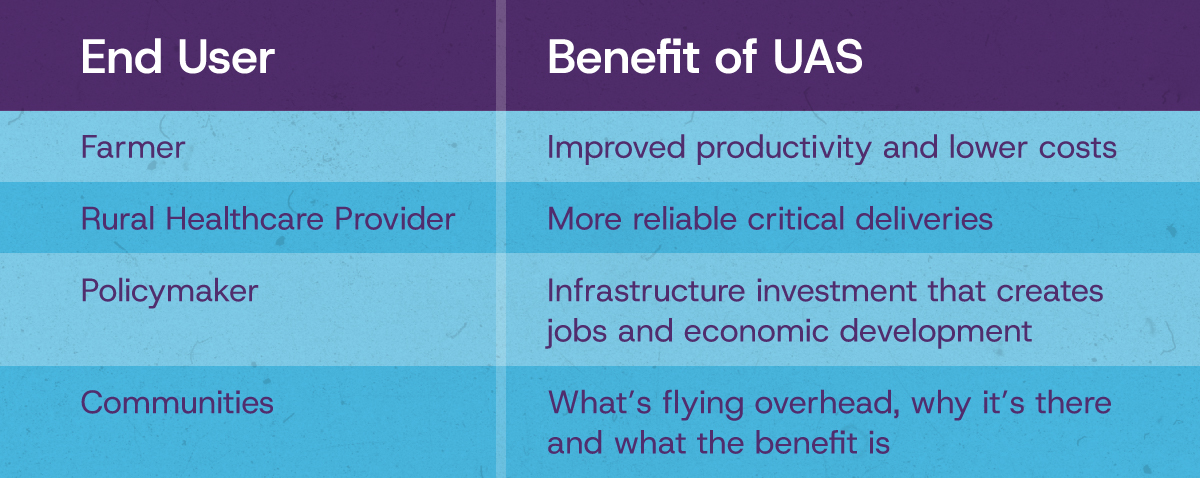
As we’ve seen repeatedly in our work in the UAS sector, technical capability alone doesn’t create adoption. Education does.
The brands and organizations that successfully commercialize autonomous technology will be those that translate sophisticated systems into clear benefits for each of these audiences.
Making UAS Connections in Kansas
Alpha Charlie attended Kelly Hills Field Day alongside our partners at the Northern Plains UAS Test Site (NPUASTS).
As part of our public relations strategy, we helped connect the NPUASTS team with key Kansas stakeholders. Those face-to-face conversations provided an opportunity to share lessons learned from developing BVLOS infrastructure and explore how that experience could support Kansas as its own unmanned ecosystem expands.
It’s the kind of work that reinforces something we regularly tell our UAS clients: meaningful industry marketing doesn’t happen exclusively through ads, websites or press releases. Sometimes the most important marketing happens by getting the right experts into the right room.
The UAS Market Is Being Built Right Now
Kelly Hills Field Day demonstrated just how quickly the unmanned industry is progressing.
The aircraft are getting more capable. Infrastructure is coming online. New commercial and defense applications are emerging. And the regulatory environment continues to evolve toward enabling more routine BVLOS operations.
The next challenge is helping customers, communities and policymakers understand what’s possible. That’s where strong UAS marketing becomes part of commercialization itself.
At Alpha Charlie, we help unmanned aviation organizations translate complex technology into stories, strategies and messages that move markets forward. If you’re building what’s next in UAS, let’s talk.