10 Questions as You Consider To Exhibit or Not to Exhibit

With the growing number of aviation tradeshows to select from each year, it becomes impossible to attend all. How do you determine which to skip?All tradeshows require investment. Consider your ROI when looking at the costs of attending and exhibiting at aviation tradeshows.
The cost of each show varies, but all demand a significant investment of resources. Both in hard costs and in people power. The average fabrication cost of a booth at larger shows is around $160 per square foot. And that doesn’t include the booth space fees. Or the creative development. Or staffing.

Don’t get me wrong. We are advocates of tradeshows. The networking they provide delivers one of the highest returns on investment in business aviation. But in an environment where we are all being asked to justify the bottom line, you have to be sure the tradeshows you’re considering draw your current and potential customers. Customers, too, are getting overwhelmed with the number of shows and are making the same ROI decisions about which to attend.

What to Ask When Determining Tradeshow ROI

  1. What is the overarching goal you are trying to accomplish by exhibiting? There are many reasons to attend: brand awareness, connecting with specific prospects or clients, launching a product, supporting an existing partnership, generating leads, solidifying existing leads. Knowing which is most important can dictate which show best delivers.

  2. Do you have the staff to support the event properly without taking away from other company initiatives? Account for the cost of prep hours, set-up time, staff for the booth and show follow-up. It adds up.

  3. What do you know about the target market that attends the show? Ensure it aligns To exhibit at an aviation tradeshow or not exhibit at an aviation tradeshow. Check your ROI.with your key prospects for business development.

  4. If two shows are close together, would you get more ROI if you focus on one versus splitting your efforts on both?

  5. If this is a show you attend annually, what’s your booth attendance been like over the last three years? Evaluate you traffic – an increase, decrease, same – to identify shifts that may be taking place.

  6. What’s the quality of your booth attendance over the past three years? You care about more than quantity. Consider whether you’re talking more to vendors than to high-quality prospective buyers of your product or service. And think about how many leads you’re converting to actual new business.

  7. Could you accomplish the same goal by having a presence, but sending a smaller group of staff and/or scaling down your booth?

  8. Have you directly asked your sales staff what tools or strategic changes you could make in your booth to provide better returns for them? The more marketing and sales talk, the better.

  9. Are there any shows that could be replaced with an alternative event where you don’t have to share attention with so many others (i.e. all the other exhibitors)?

  10. How are you tracking tradeshow ROI after the event? Ensure you have an action plan for the leads you generate and that you have the capacity to properly handle follow up.

If In Doubt, Lean Toward Attending

These questions offer a starting point for discussion. I hope they prompt some rigorous debate. NBAA 2015 is now only 16 weeks away. So as you plan, consider what efforts would produce the greatest ROI. There’s still time to adjust.

This column ran in the July 30 issue of BlueSky Business Aviation News. 

Give Your Brand a Fresh Start

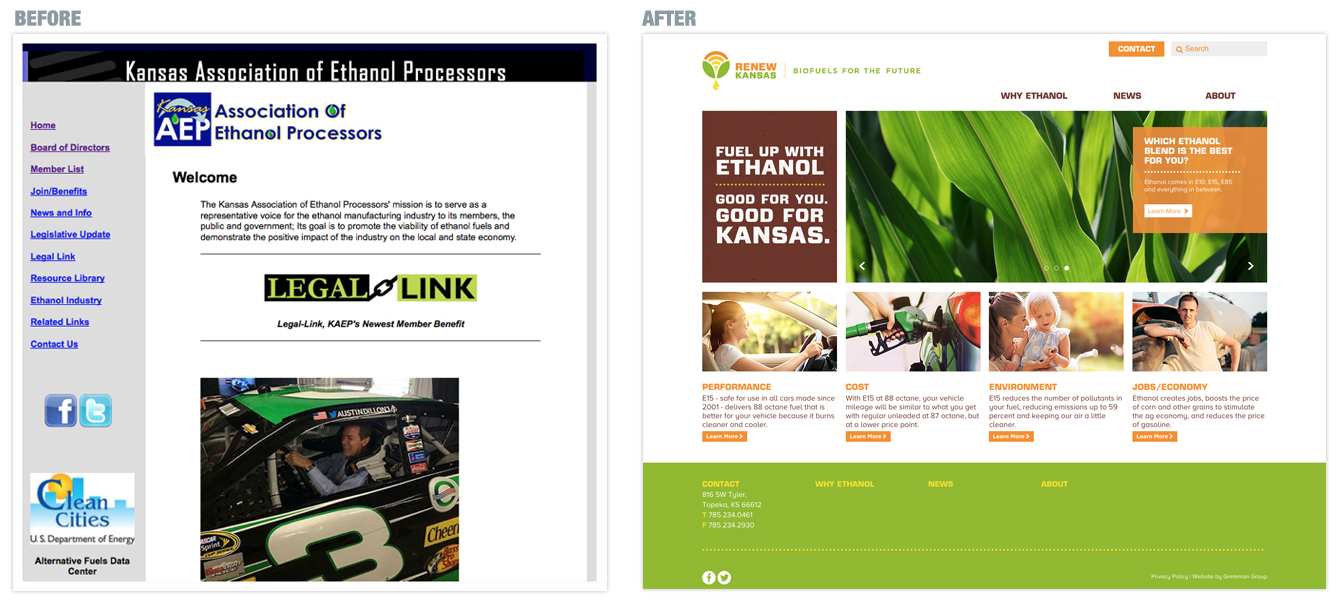
It takes courage to ditch the old and begin again. But that’s just what the Kansas Association of Ethanol Processors did with its brand. The board of directors realized it needed a better outreach platform for its various initiatives – which get technical quick, face entrenched opposition from Big Oil and may someday include biofuels in addition to ethanol.

Simplifying Complexity

We began by renaming the group. Renew Kansas captures biofuels’ earth-friendly essence as well as the revitalizing effect their production can have. The new logo evokes growth, agriculture and the environment – reinforced by the tagline, Biofuels for the Future. The full brand pulls it all together to promote sustainability and benefits in automotive performance, cost, the environment and the economy.

A responsive and SEO-laden website reinforces why ethanol is – Good for You. Good for Kansas. Quick facts speak to consumers’ most-asked questions. Why ethanol? gets explored and answered. The site provides enough authoritative information to satisfy, but doesn’t try to serve as a clearinghouse for all things ethanol. It provides links to solid, credible sources for more detailed study. And an ethanol retailer near you.

website before and after

Tools to Go the Distance

Renew Kansas now has what it needs to take on specific projects, such as a statewide E15 campaign. These initiatives inspire a greener tomorrow. And we’re all for that.


Fly to Make the Deal, Insights from Hotel Magnate Jack DeBoer

Few entrepreneurs extol the virtues of business aviation as well or as colorfully as Jack DeBoer. The hotel magnate has used aircraft throughout his storied career – from being one of the largest apartment builders in the United States in the early 1970s to founding four hotel brands: Residence Inn, Summerfield Suites, Candlewood Suites and Value Place. He pioneered the concept of extended-stay and all-suite hotels.

Up Close With the Citation Latitude

DeBoer hosted the Wichita Aero Club’s July meeting at his hangar at Jabara Airport. He shared billing with a gleaming, new Cessna Citation Latitude making its first local public appearance. The $16 million midsize jet received Federal Aviation Administration (FAA) type certification in June. Textron Aviation CEO Scott Ernest and Cessna Chairman Emeritus Russ Meyer were both on hand for plane talk. And there’s a lot to discuss. A new fuselage design. A 2,700-nautical-mile range at high-speed cruise. The most spacious cabin in its category. A longtime Cessna-aircraft owner, the towering DeBoer seemed most impressed with its flat floor and 6-foot-tall cabin.


Russ Meyer gives DeBoer a tour of the plane
Cessna Chairman Emeritus Russ Meyer gave DeBoer a tour of the plane before the presentation. DeBoer was particularly smitten with the flat floor and cabin height of six feet – so DeBoer only had to duck a little.

The Need for Speed

Jack DeBoer
DeBoer’s impassioned brand of aviation evangelism met a receptive audience at the Wichita Aero Club’s July meeting.

An anecdote DeBoer shared illustrates how he could never have accomplished what he has in his career without private aircraft. He told of a time back in the Residence Inn days, when he was sitting in the back of his ready-to-takeoff Learjet 24, about to kick back with a bottle of scotch. He got a call from a broker with a hot land deal a seller wanted to make. Now. DeBoer tucked the bottle away, walked up to the cockpit (well, more like crawled, he said, since it wasn’t a stand-up cabin) and instructed the crew of the change in destination. “That one deal paid for all this bullshit,” DeBoer said gesturing about him.

Time and again, business aircraft have proven to be vital business tools – when used correctly. “Airplanes make money. Airplanes also cost money,” said DeBoer. “Don’t do it on the cheap. That’s how people get hurt.”

Insights From the Left Seat

An experienced pilot with 6,000 flight hours, DeBoer credits his stellar safety record with “always flying with someone better than me.” He holds the 3-kilometer world speed record for jet aircraft under 18,000 pounds. In 1988, he and his wife, Marilyn, flew his Gulfstream II around the world in a four-month, life-changing journey to study the world’s most pressing needs.

This led to their current, deep involvement with World Vision. Today, even at age 84, it takes a fleet of aircraft to keep up with him and his management team. DeBoer acknowledged that business aircraft can be used for non-business purposes. “But that’s not why you have them,” he said. “No one can operate them just for fun.”

Time To Do Things Right

DeBoer primarily spoke about his use of aircraft for business, but he also ballyhooed his largely unsung enterprise, Wichita Air Services. It employs a dozen people, operates and manages five private aircraft, has brought home multiple wins from Oshkosh and Reno and, quite impressively, has operated jet aircraft without incident for 47 years. A branch north of Wichita restores war birds and vintage aircraft from around the world. A recently renovated Lockheed Electra will soon head to a museum in Prague, Czech Republic.

Risk Only Money book
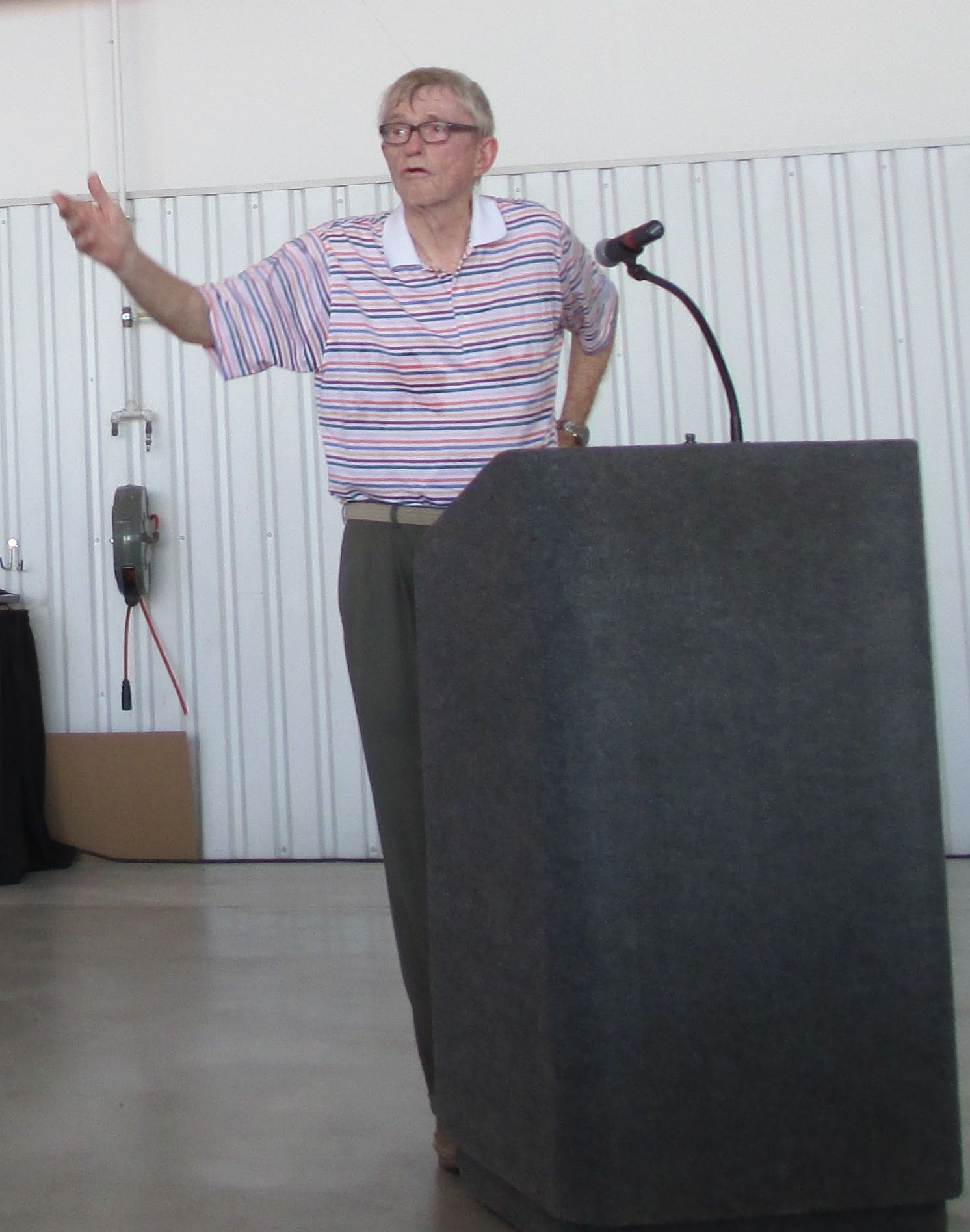
More than a hundred people braved the sweltering heat to hear Jack DeBoer speak and get a first-time view of the Cessna Citation Latitude at the July 13 Wichita Aero Club meeting.

Telling It Straight

Stimpson and Humphrey scholarship winners
The reception celebrated the new Wichita Aero Club Stimpson and Humphrey scholarship winners, Michael Parker and Karen Morrison of Kansas State University and Bryan Cox from Wichita Area Technical College. Pictured here, Wichita Aero Club Board President Jeff Pier and President Dave Franson present the Stimpson scholarship.

DeBoer also drew from his book, Risk Only Money, and the business lessons he shares in its pages. That could be one of DeBoer’s greatest strengths as a presenter. He doesn’t just highlight what went right in his career, but also his mistakes. The things he had to learn the hard way. He spoke about the perils of ego and how it led to losing his multimillion dollar apartment empire decades ago and even receiving a death threat from one of the many people he owed money. He talked about hitting bottom, then climbing back. Working to achieve success, yes, but even more, to achieve a life of significance.

DeBoer believes there are things we should never jeopardize: family, reputation, self-respect, friendships, health. But money? To him, capital exists to risk, gain, lose and reclaim. And then to do it all over again. As DeBoer points out, win or lose, tomorrow the game begins again. And if you have an aircraft to seal the deal, all the better.

Books

This column ran in the July 16 issue of BlueSky Business Aviation News. 


Kansas Ag Network; Kansas Association of Ethanol Processors Changes Name to Renew Kansas

Topeka, KS – The Kansas Association of Ethanol Processors, the statewide trade association representing ethanol producers in Kansas, announced that it has changed its organization name to Renew Kansas. The new name reflects an evolution of the association’s mission to promote ethanol as a renewable fuel that is good for the Kansas consumer, environment and economy.

The transition comes after months of strategic planning and analysis by the KAEP Board of Directors and staff. The Greteman Group, an advertising agency in the Wichita area, directed the rebranding efforts with a new logo, website and industry messaging.

“Changing our name to Renew Kansas better reflects our focus in promotion and education of ethanol fuels as good for consumers and the state,” said Tom Willis, CEO of Conestoga Energy Partners in Liberal and Chairman of the KAEP Board of Directors. “We look forward to expanding our reach with our new identity and growing our organization to help meet future energy needs.”

The Renew Kansas website, www.renewkansas.com, will be a valuable resource promoting ethanol fuels, dispelling myths, educating the government and public about the many significant benefits of ethanol, and demonstrating the industry’s positive impact on health, the environment and our local and state economies.

This article, written by Greg Akagi, was originally posted on the Kansas Ag Network website.